Why Commercial Property Claims Develop Supplements After the First Estimate
A commercial property estimate can look complete on day one and still change significantly once repairs begin. That does not automatically mean the original estimate was poorly written. Commercial losses are complex, buildings reveal information in stages, and the true repair requirements are not always visible during the first inspection.
But when supplements become frequent, large, or unexpected, they create real operational problems. Cycle time increases. Adjusters spend more time revisiting files. Contractors and carriers may disagree over scope. Policyholders wait longer for clarity. What begins as a relatively small estimating difference can turn into additional inspections, documentation requests, approvals, and negotiations.
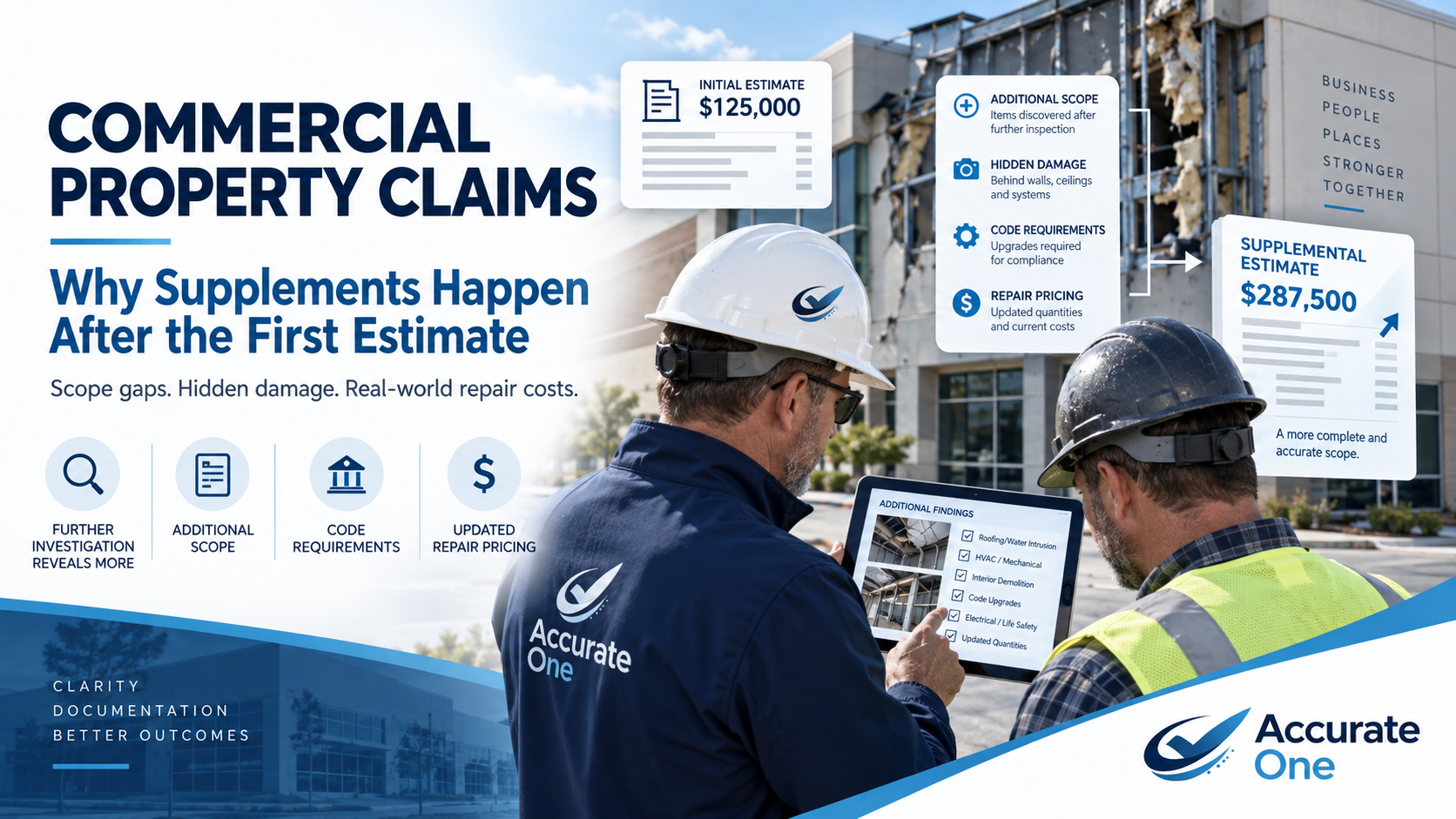
Understanding why supplements develop is the first step toward reducing the ones that can be prevented.
The First Estimate Is Built on the Information Available at the Time
Every estimate depends on what was captured during the inspection. If damage is concealed behind walls, above ceilings, below flooring, or inside mechanical systems, the complete repair scope may not be apparent initially.
Commercial properties add another layer of complexity. Different construction materials, larger mechanical systems, code requirements, specialized finishes, tenant improvements, accessibility considerations, and business operations can all affect how repairs must ultimately be performed.
Once demolition begins or a contractor examines the project from a repair perspective, additional conditions may become visible. That new information can legitimately change the scope.
Where Preventable Supplements Often Begin
Some supplements are unavoidable. Others begin with gaps that could have been addressed earlier in the claim.
- Incomplete documentation: Missing photographs, measurements, room details, material identification, or damage descriptions can leave important questions unanswered.
- Scope differences: The original estimate may identify the damaged component but not fully account for the actual repair sequence required to restore it.
- Pricing differences: Standard estimating data may not always reflect the contractor availability, labor conditions, material costs, or specialized trades required for a particular commercial project.
- Code and access requirements: The repair may trigger additional requirements that were not obvious during the initial inspection.
- Disconnected information: When photos, notes, estimates, reports, and contractor information are reviewed separately, inconsistencies can survive longer than they should.
The Contractor Often Sees the Loss Differently
An adjuster is evaluating damage, coverage-related documentation, and an appropriate estimate based on the information available. A contractor is approaching the same property from the standpoint of physically performing the repair.
Those perspectives can expose differences.
The contractor may identify required labor steps, access limitations, sequencing issues, equipment needs, material availability, or repair methods that were not fully represented in the first estimate.
That is one reason contractor-backed estimating can be valuable. Bringing real-world construction knowledge into the estimating process earlier can help create scopes that more closely reflect how the work will actually be completed. The objective is not to inflate an estimate. It is to improve the connection between the written scope and the physical repair.
The goal should not be zero supplements at any cost.
The goal is to reduce avoidable supplements by improving the quality of the information, scope, pricing, and review before the claim moves further downstream.
Better Capture at the Beginning Creates Better Decisions Later
Strong documentation can make a significant difference in commercial property claims. More complete imagery, accurate measurements, clear records, and detailed property information give estimators and reviewers more to work with before repair begins.
Technologies such as 3D property documentation can help create a more complete record of the loss. Instead of relying only on selected photographs and handwritten measurements, claims teams can preserve a broader view of the property and damaged areas for later review.
That can reduce questions, help limit unnecessary reinspections, and give desk teams better information when evaluating scope.
Review Before the Estimate Moves Forward
Another opportunity exists between writing the estimate and allowing the claim to advance.
A complete claim-file review can identify inconsistencies between the estimate, photographs, reports, notes, and other documentation. Accurate One’s ACE — Accurate Claims Examiner — is designed to support that review process by analyzing claim information and identifying potential scope, documentation, estimating, and file-quality concerns for human review.
The technology does not replace the adjuster’s judgment. It gives claims professionals another opportunity to find questions before those questions become supplements, disputes, or delays.
Supplements Have a Cost Beyond the Additional Estimate
Every avoidable supplement adds another cycle to the claim. Someone has to receive it, review it, compare documentation, communicate with the contractor, obtain additional approvals, revise the estimate, and explain the change.
That affects more than claim cost. It affects cycle time, workload, communication, and ultimately the policyholder experience.
Commercial property claims will always contain variables, and some supplements will always be legitimate. The opportunity is to reduce the preventable ones.
Better field capture, real-world repair knowledge, stronger estimating, and broader file review can move more questions to the beginning of the claim — where they are usually easier and less expensive to resolve.
Strengthen the Estimate Before the Supplement
Accurate One combines claims experience, advanced property documentation, contractor-backed estimating, and AI-assisted file review to help carriers identify issues earlier and move claims forward with greater confidence.