Beyond the Flood Zone: How Unexpected Flood Claims Drive Delays, Customer Friction, and Higher Costs
Unexpected flood losses do more than increase claim volume. They expose weaknesses in documentation, estimating, review capacity, communication, and operational readiness.

Flooding does not stop at the boundary of a high-risk flood zone. When claims operations are unprepared, the consequences can spread from one incomplete inspection into longer cycle times, policyholder frustration, repeated estimate revisions, and higher claim costs.
For homeowners, an unexpected flood can create a sudden financial and emotional crisis. For insurance carriers, the same event can expose weaknesses in field documentation, estimating, staffing, file review, communication, and workflow capacity.
Expanding flood risk is not only a coverage issue. It is an operational-readiness issue.
Flood maps remain important, but they describe relative risk—not immunity. Heavy rainfall, overwhelmed drainage systems, inland tropical systems, saturated soil, river overflow, rapid development, snowmelt, and dam or levee failures can affect properties far outside traditionally recognized high-risk areas.
FEMA has reported that flooding has affected nearly every county in the United States and that a substantial share of National Flood Insurance Program claims come from properties outside designated high-risk flood areas. FEMA also estimates that one inch of water can cause approximately $25,000 in property damage.
For carriers, the strategic question is no longer simply where flooding will occur. The more important question is whether the claims operation can respond accurately, consistently, and at scale when flooding reaches places where policyholders—and the organization—did not expect it.
What Carriers Should Take Away
- Flood losses increasingly occur beyond traditionally recognized high-risk areas.
- Policyholder misunderstanding quickly becomes communication and customer-experience friction.
- Incomplete initial documentation creates downstream estimating and review problems.
- Additional staffing does not solve inconsistent methodology or weak quality control.
- Better outcomes require connected field, estimating, review, and workflow capabilities.
Homeowner Confusion Becomes a Carrier Problem
Many homeowners still associate flooding with coastal communities, riverfront properties, and locations clearly identified on flood maps. That perception can create a dangerous sense of security.
A lower-risk designation does not mean a property cannot flood. Drainage systems can become overwhelmed. New roads, parking lots, and developments can change the direction and speed of runoff. Saturated soil may no longer absorb additional rainfall. Small creeks and drainage channels can rise rapidly, and tropical systems can produce severe inland flooding hundreds of miles from the coast.
When that happens, the homeowner may be surprised not only by the damage, but also by the insurance implications. Standard homeowners and renters policies generally do not cover damage caused by flooding. Flood protection usually requires separate coverage, and many policyholders do not fully understand that distinction until after water has entered the property.
At that point, the homeowner may be displaced, financially overwhelmed, and trying to understand:
- What is covered and what documentation is required?
- Who will inspect the loss and how will damage be evaluated?
- What can be removed, repaired, or discarded?
- How long will the claim take?
- What happens next?
For the carrier, those questions create immediate pressure on communication, inspection capacity, policy interpretation, estimating, and customer service. The homeowner’s experience and the carrier’s operational performance are not separate issues. They are two sides of the same claim.
The Flood Claim Cascade
Flood claims often become more difficult because problems created at the beginning move downstream.
Unexpected loss → Policyholder confusion → Incomplete capture → Scope uncertainty → Review gaps → Delayed resolution → Higher cost
A weak initial inspection does not remain an inspection problem. It becomes an estimating problem. Then it becomes a review problem. Eventually, it becomes a cycle-time, customer-experience, and cost problem.
Flood conditions can change quickly after the event. Standing water may be extracted, damaged materials removed, contents relocated, and emergency work started before the full loss has been documented.
If critical evidence is not captured early, claims teams may later struggle to determine:
- The original water level and full extent of affected areas
- Which materials, systems, and contents were damaged
- Whether measurements and quantities are accurate
- Whether the repair scope reflects actual conditions
- Whether the file supports the final claim decision
The result can be repeated calls, reinspections, supplements, estimate revisions, escalations, and longer claim duration. That is why the first inspection can shape the entire claim.
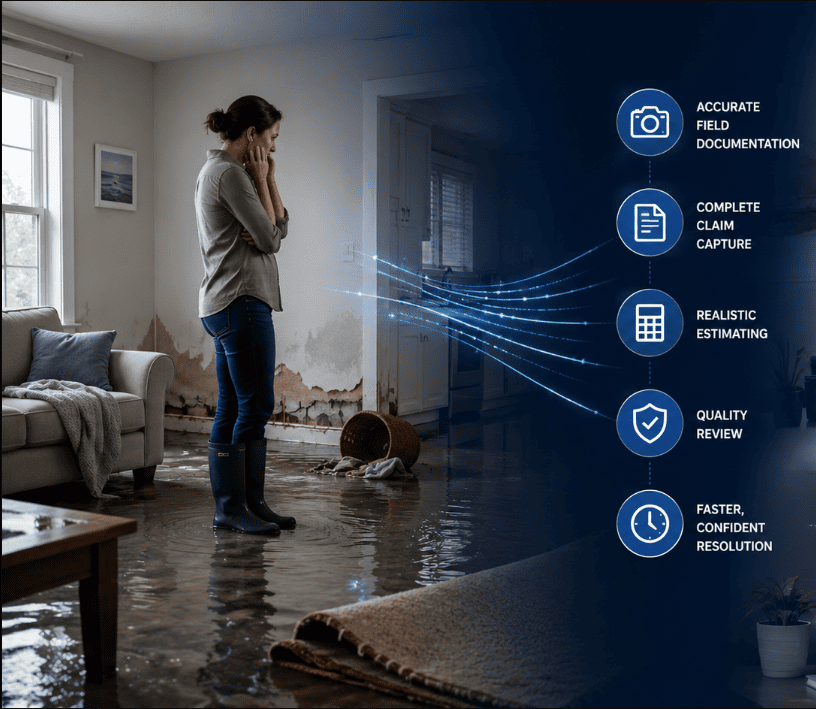
The policyholder experience and carrier workflow are two sides of the same claim.
Homeowner Education Can Reduce Preventable Friction
Carriers cannot eliminate every misunderstanding about flood risk, but clear education can reduce avoidable confusion before and after a loss.
Homeowners should be encouraged to speak with a qualified insurance professional about:
- Whether flooding is covered and whether separate flood insurance is appropriate
- Building and contents protection, limits, and deductibles
- Waiting periods, valuation provisions, and restrictions
- What documentation should be preserved after a loss
- What steps to take before cleanup or disposal begins
They should also understand that flood insurance generally cannot be purchased after a storm is approaching and expected to provide immediate protection. Preparation must occur before the event.
A policyholder who understands the process is better prepared to report the loss, preserve documentation, respond to requests, and participate in the claim. Education does not replace a strong claims operation, but it can reduce unnecessary friction.
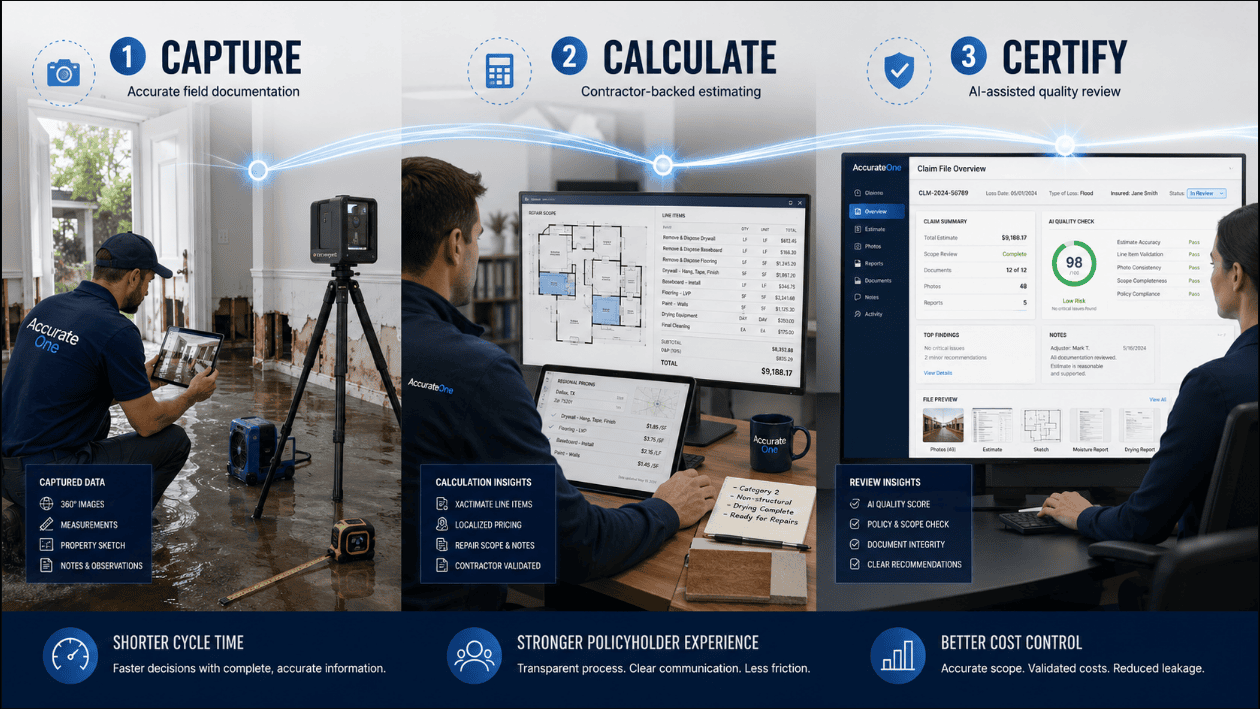
Accurate outcomes depend on a connected process: complete capture, realistic calculation, and full-file certification.
The Operational Response: Capture, Calculate, Certify
Accurate One’s response to the Flood Claim Cascade is built around the 3C Framework: Capture, Calculate, Certify. These are not isolated services. They are connected disciplines designed to improve the quality of the claim from the field through final review.
Capture
Capture means gathering complete, accurate field documentation from the start, including imagery, measurements, inspection data, materials, contents information, loss details, and supporting records.
Three-dimensional imaging can give claims teams a more complete and accessible view of the property than selected photographs and disconnected measurements alone. The value is not simply the technology. The value is fewer unanswered questions, fewer reinspections, and less scope uncertainty.
Calculate
Complete documentation must be translated into a realistic scope and estimate. Flood estimating requires more than entering line items into software.
The estimate must reflect actual property conditions, repair sequencing, regional labor and material pricing, remediation needs, access requirements, and how the work would realistically be performed. Accurate One uses contractor-backed estimating and field-informed judgment to help align the scope with real repair conditions.
Certify
Flood files may contain hundreds of pages of estimates, notes, photographs, reports, inventories, invoices, policy information, correspondence, and compliance documentation.
ACE—the Accurate Claims Examiner—supports complete-file review by analyzing claim materials for inconsistencies, documentation gaps, scope concerns, potential leakage, missed items, and compliance risks.
Human reviewers validate the findings, apply professional judgment, resolve issues, and move the claim forward with greater confidence. ACE supports adjusters and organizations; it does not replace them.
Operational Readiness Requires More Than Staffing
When flood volume rises, carriers may need more adjusters, inspectors, estimators, contents resources, reviewers, and catastrophe support. But adding people alone does not create readiness.
A scalable operation also needs:
- Consistent inspection standards and clear documentation requirements
- Realistic estimating methodology and effective file-review processes
- Defined escalation, reporting, and quality-control procedures
- Workflow continuity between field, desk, review, and leadership teams
- Communication that keeps policyholders and stakeholders informed
Without those controls, additional resources may increase activity without improving outcomes. Accurate One can support the full claim lifecycle or be deployed where a carrier is experiencing a specific bottleneck.
Why Accurate One Is Different
Not inspection alone: Our field documentation is designed to improve the decisions that follow.
Not estimating software alone: Our scopes are supported by contractor-backed methodology, regional pricing, and real repair knowledge.
Not AI alone: ACE is paired with human expertise, quality control, and operational oversight.
Not another disconnected vendor: API-enabled capabilities can support workflow continuity, reduce manual handoffs, improve data flow, and help Accurate One fit within existing carrier operations.
Communication and transparency are embedded throughout Accurate One’s culture, methodology, and delivery. They are not a fourth step in the framework; they support every stage of the claim lifecycle.
Is Your Flood-Claims Operation Ready?
- Can field teams create a complete digital record during the first inspection?
- Can inspection, estimating, contents, and review capacity scale without sacrificing consistency?
- Can the organization review complete files and identify issues before they delay resolution?
- Can information move between systems and teams without excessive manual work?
- Can leadership see where claims are slowing down and why?
Better Flood Claims Produce Better Outcomes
Cycle Time
Complete capture reduces follow-up requests and reinspections. Accurate estimating reduces revisions and supplements. Expanded review identifies issues before they delay closure.
Customer Experience
Policyholders receive clearer communication and are asked for information fewer times. They gain confidence that the loss was documented thoroughly and evaluated accurately.
Cost Control
Better documentation reduces missed and unsupported items. Contractor-backed estimating limits repeated corrections. Expanded review helps identify leakage, inconsistencies, and compliance concerns.
Cost control is not achieved by simply reducing an estimate. It is achieved by improving the quality and efficiency of the entire claim process.
Prepare Before the Water Rises
Flood risk may be difficult to predict. The operational response should not be.
An informed homeowner is better prepared to protect the property and participate in the claim. A prepared carrier is better positioned to respond with speed, clarity, accuracy, and control.
Accurate One helps connect those needs through professional field capture, contractor-backed estimating, AI-assisted full-file review, quality control, scalable claims resources, human oversight, and workflow integration.
The result is shorter cycle time, a stronger policyholder experience, and better control over the total cost of the claim.
Strengthen Your Flood-Claims Readiness
Start with ACE for immediate AI-powered claim-file review, or speak with Accurate One about inspection capacity, estimating, contents, catastrophe support, compliance, and workflow integration.