THE AI CLAIMS DILEMMA:
How Do Carriers Move Faster Without Losing Accuracy or Human Judgment?
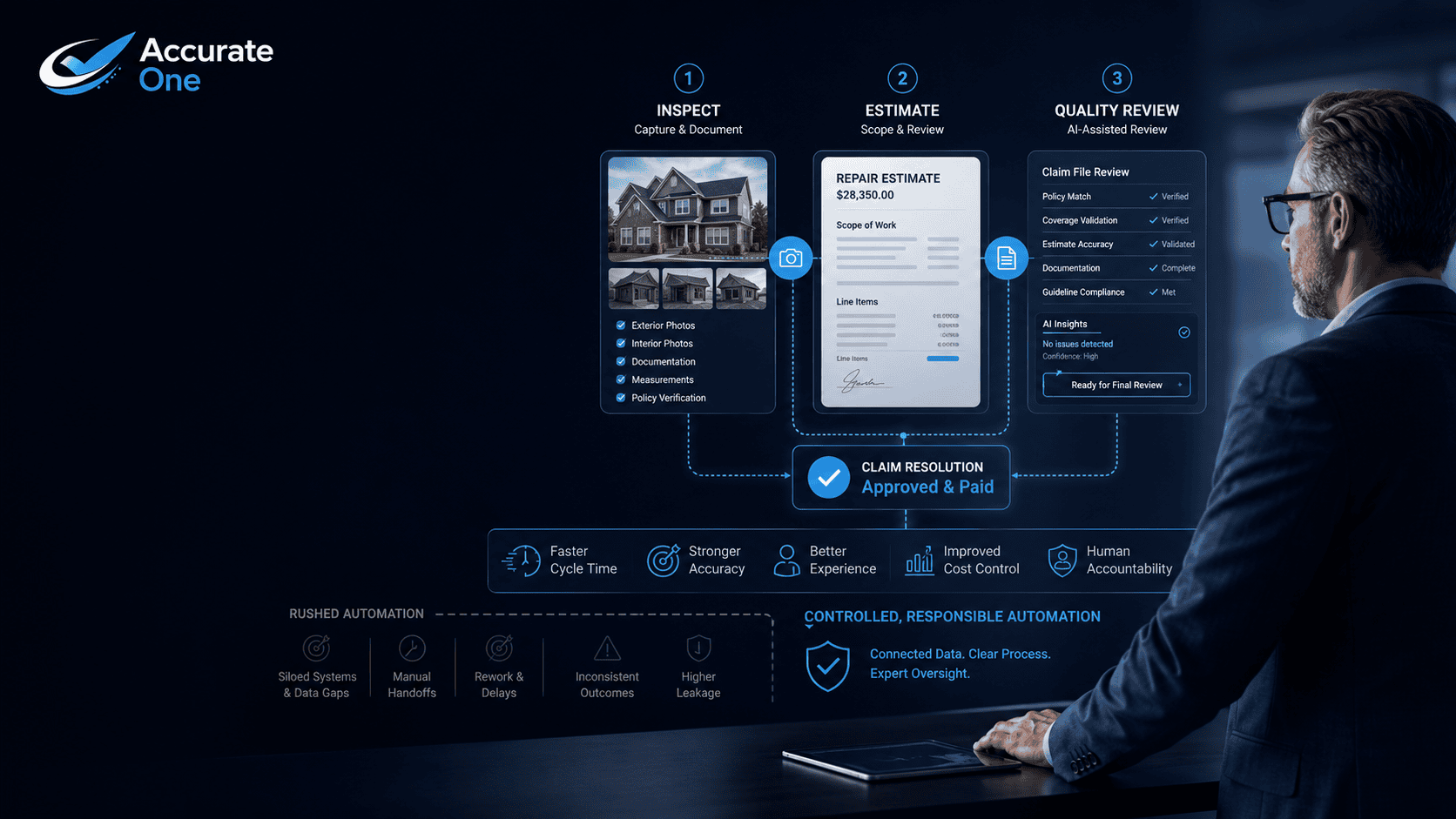
Insurance carriers are under growing pressure to resolve claims faster.
Policyholders expect immediate communication, simpler processes, and quicker decisions. At the same time, claims organizations must manage rising repair costs, staffing constraints, catastrophe volatility, regulatory requirements, and increasingly complex files.
Artificial intelligence offers a powerful response. It can process large volumes of information, automate repetitive tasks, review documentation, and help identify issues that might otherwise take hours to uncover.
How can carriers use AI to accelerate claims without sacrificing accuracy, oversight, or human judgment?
That is the AI claims dilemma. The answer is not to resist automation, but it is also not to automate every decision simply because technology makes it possible.
The opportunity is to use AI where it creates meaningful operational value while keeping experienced claims professionals responsible for interpretation, communication, and final decisions.
Speed Alone Is Not the Goal
Carriers must respond quickly after a loss, document damage, evaluate coverage, prepare accurate estimates, review complex files, and keep the policyholder informed throughout the process.
Moving an incomplete or inaccurate claim faster does not solve the problem. It simply pushes the problem further down the workflow, where it may become rework, a supplement, a dispute, a delayed payment, or a dissatisfied policyholder.
The objective should be faster, more accurate, and more controlled claim resolution.
Where AI Creates Value
A property claim file may contain estimates, photographs, inspection reports, adjuster notes, invoices, policy information, correspondence, and regulatory documents. Reviewing every part of the file manually can be difficult, especially when claim volume rises.
Used properly, AI-assisted review can help claims teams:
- Reduce repetitive administrative work
- Expand review coverage
- Improve consistency across files
- Surface potential problems earlier
- Focus professionals on higher-value decisions
This does not mean AI should independently decide whether a claim is covered, what should be paid, or whether a denial is justified. It means technology can help the professional reviewer see more, sooner.
Automation Has Limits
Straight-through processing can work well for simple, low-severity claims that meet clearly defined criteria. The danger begins when every claim is treated as though it carries the same level of complexity.
A photograph may show visible damage without explaining its cause. An estimate may contain technically correct line items while still missing the true repair scope. A routine-looking file may contain notes or correspondence that reveal a larger coverage or documentation concern.
Human professionals recognize context. AI can organize and analyze information, but professional judgment remains essential whenever interpretation is required. The strongest automation strategy is selective—not universal.
AI-Generated Fraud Raises the Stakes
Generative AI is also making claim fraud more sophisticated. Damage photographs can be altered. Invoices and supporting documents can be fabricated. Claim narratives can be generated to appear convincing and internally consistent.
Claims teams must compare information across the complete file. Do the photographs support the estimate? Does the repair scope align with the reported damage? Do invoices, measurements, notes, and timelines agree?
AI can help identify contradictions, but suspicious activity still requires investigation, professional analysis, and documented reasoning. The response to AI-enabled fraud must combine better technology with stronger human oversight.
Explainability Matters
A technology-supported review should clearly explain:
- What information was evaluated
- What issue was identified
- Why the issue was flagged
- What requires human attention
Claims professionals must be able to review, challenge, and override AI findings when appropriate. A fast answer without transparency creates a different kind of operational risk.
Human Judgment Is Not the Problem
Human involvement is often blamed for slow claims. In reality, many delays come from incomplete documentation, duplicated work, disconnected systems, unclear responsibilities, and preventable handoffs.
AI should reduce that burden so adjusters and reviewers can focus on evaluating context, applying policy language, resolving conflicting information, assessing realistic repair scopes, and communicating with policyholders.
The strongest operating model is not human versus AI. It is human expertise supported by technology.
A Responsible AI Model
Carriers should begin with the workflow rather than the technology. A responsible AI-enabled claims model should include:
- Clearly defined use cases and decision boundaries
- Human accountability and review authority
- Complete claim documentation and explainable findings
- Escalation, exception, and quality-control procedures
- Ongoing validation and transparent communication
This approach improves efficiency without surrendering operational control.
How Accurate One Approaches the Dilemma
Accurate One is technology-enabled but human-led. Its claims services combine licensed professionals, advanced property documentation, contractor-backed estimating, quality assurance, and AI-assisted claim-file review.
ACE—Accurate Claims Examiner—is designed to analyze complete claim files and help identify documentation gaps, estimate concerns, inconsistencies, and issues requiring professional attention.
The purpose is not to replace the adjuster or reviewer. It is to expand review capacity, reduce manual workload, improve consistency, and provide greater visibility before the claim moves forward.
The goal is better performance across three critical outcomes: cycle time, customer experience, and cost control.
The Future Must Be Faster and Better
AI will continue to reshape claims operations. Carriers that use it responsibly may gain faster processing, broader review coverage, stronger consistency, and better operational visibility.
But technology cannot become an excuse to weaken documentation, remove accountability, or distance professionals from consequential decisions.
The future of claims should not force carriers to choose between speed and accuracy. It should help them improve both.
AI can help claims move faster. Human judgment ensures they move in the right direction.
Great insight. AI technology will help align adjusting.
Thank you so much. Have a great day!