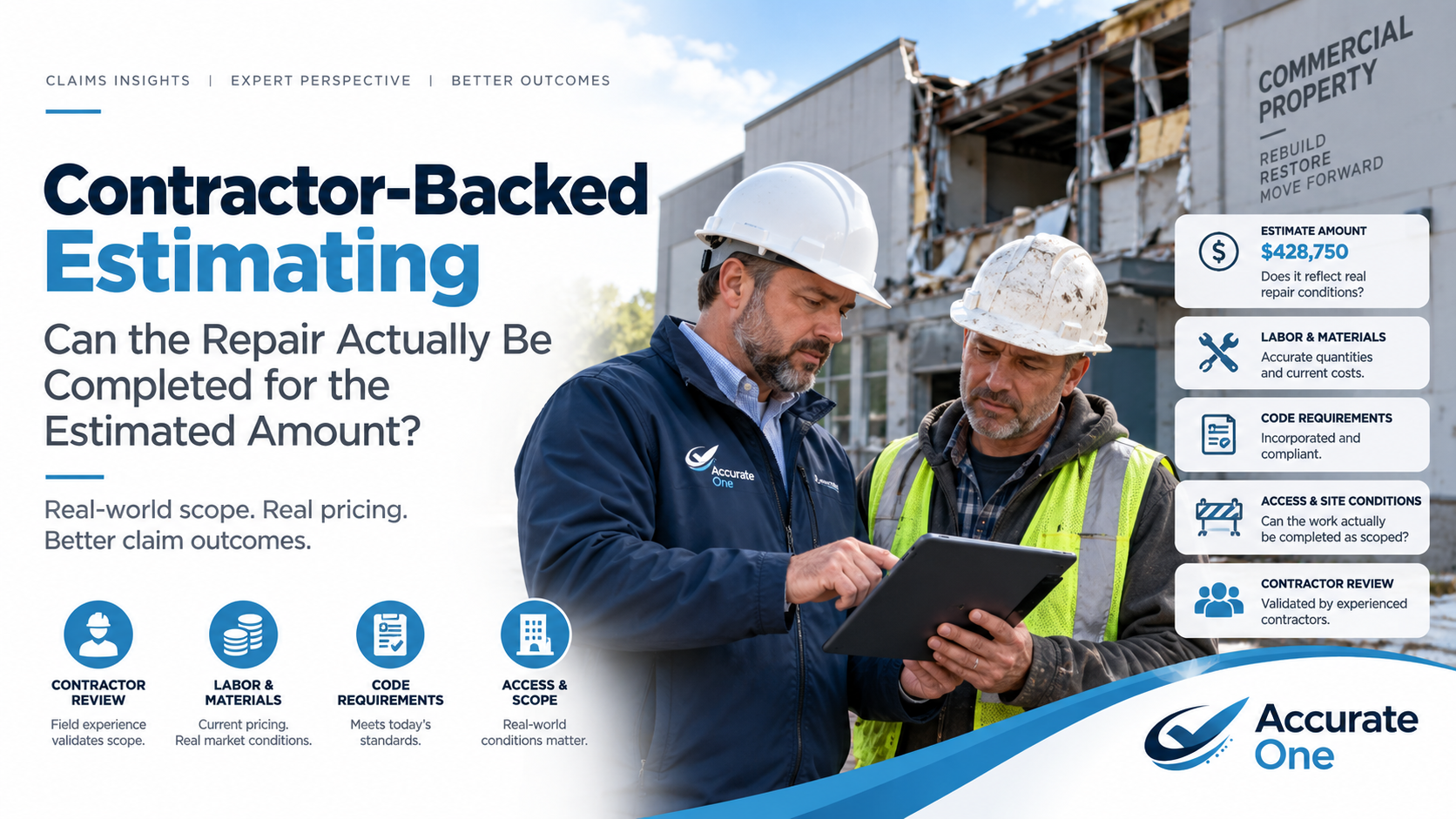
Contractor-Backed Estimating: Can the Repair Actually Be Completed for the Estimated Amount?
An estimate can be technically complete, properly formatted, and still leave one important question unanswered: can a qualified contractor actually perform the repair for the amount shown?
That question matters because the estimate does more than assign a dollar value to a loss. It becomes the financial roadmap for the repair. When the scope, labor assumptions, material pricing, or repair methodology do not reflect real-world conditions, the gap usually appears later.
That is when supplements begin, contractors challenge the scope, adjusters revisit the file, and policyholders are left wondering why the original estimate did not match the actual cost of the work.
Contractor-backed estimating is designed to bring the repair perspective into the process earlier.
An Estimate Is Only as Strong as the Assumptions Behind It
Estimating platforms provide valuable structure, standardized pricing data, and consistency. But software cannot always account for every condition that affects how a repair will actually be completed.
Commercial properties can involve specialized materials, complex access, occupied spaces, staging requirements, equipment, regional labor conditions, code upgrades, and sequencing issues that may not be obvious from the estimate alone.
A line item may be correct in theory while the actual repair requires additional steps to make that line item possible.
That distinction is where real-world construction knowledge becomes valuable.
The Contractor Looks at the Claim Through a Different Lens
An adjuster is evaluating the loss, documenting damage, considering coverage, and developing an estimate based on the information available.
A contractor approaches the same property with a different question:
What will it actually take to perform this repair correctly?
That perspective includes labor sequencing, material availability, demolition requirements, access limitations, equipment needs, waste, protection of adjacent areas, and the practical realities of putting the property back together.
When that construction perspective is introduced only after the estimate has already been completed, disagreements may develop downstream.
Contractor-backed estimating moves that conversation closer to the beginning.
Where Estimate-to-Repair Gaps Commonly Develop
Several areas can create a difference between what appears in an estimate and what is required in the field:
- Labor assumptions: The estimated labor may not fully reflect the complexity, access, or sequencing required to complete the work.
- Material pricing: Local availability, freight, specialty products, or rapidly changing market conditions can affect actual replacement costs.
- Scope completeness: A repair may require related work that is necessary to access, remove, replace, or reinstall the damaged component.
- Code requirements: Existing conditions may trigger upgrades or additional work that was not included in the initial scope.
- Site conditions: Occupancy, height, staging, safety requirements, equipment, and operating constraints can materially change how work must be performed.
The Goal Is Not a Higher Estimate. It Is a More Defensible One.
Contractor-backed estimating should not be viewed as a mechanism for automatically increasing claim values.
The objective is accuracy.
If the original estimate accurately reflects the repair, contractor review may confirm it. If there are missing steps, unrealistic assumptions, or pricing concerns, they can be identified before those differences become larger operational problems.
A stronger estimate gives the carrier, adjuster, contractor, and policyholder a clearer starting point.
That clarity can reduce unnecessary negotiation and help prevent the repeated cycle of estimate, supplement, review, revision, and reapproval.
Better Estimates Can Improve More Than Cost Control
When an estimate better reflects the repair from the beginning, the benefits extend beyond the dollar amount.
Adjusters spend less time reopening files. Contractors have a clearer scope to work from. Claims teams face fewer avoidable handoffs. Policyholders receive greater clarity about what happens next.
That can support three outcomes that matter throughout the claim: better cycle time, stronger cost control, and a smoother customer experience.
The alternative is allowing the repair process to reveal problems that could have been identified earlier.
Bringing Real-World Repair Knowledge Into the Claim
Accurate One uses contractor-backed estimating to help connect claim estimating with real-world construction methodology and pricing.
That means looking beyond whether an estimate contains the expected line items and asking whether the overall scope reflects how the repair can realistically be performed.
Combined with detailed property documentation and experienced claims judgment, that approach can help identify scope and pricing questions earlier, when they are generally easier to address.
No estimating process can eliminate every supplement or unexpected condition. Commercial losses are too complex for that.
But there is a meaningful difference between a supplement caused by genuinely hidden damage and one caused by a repair requirement that could have been identified from the beginning.
Can the Repair Actually Be Completed for the Estimated Amount?
Accurate One combines experienced claims professionals with contractor-backed estimating, advanced property documentation, and technology-enabled review to help create stronger, more realistic claim scopes before problems move downstream.