When the Claim Estimate and the Repair Bid Don’t Match, What Happens Next?
For municipalities managing commercial property claims, the real challenge is not simply producing an estimate. It is having confidence that the scope and pricing will hold up when the repair work actually begins.
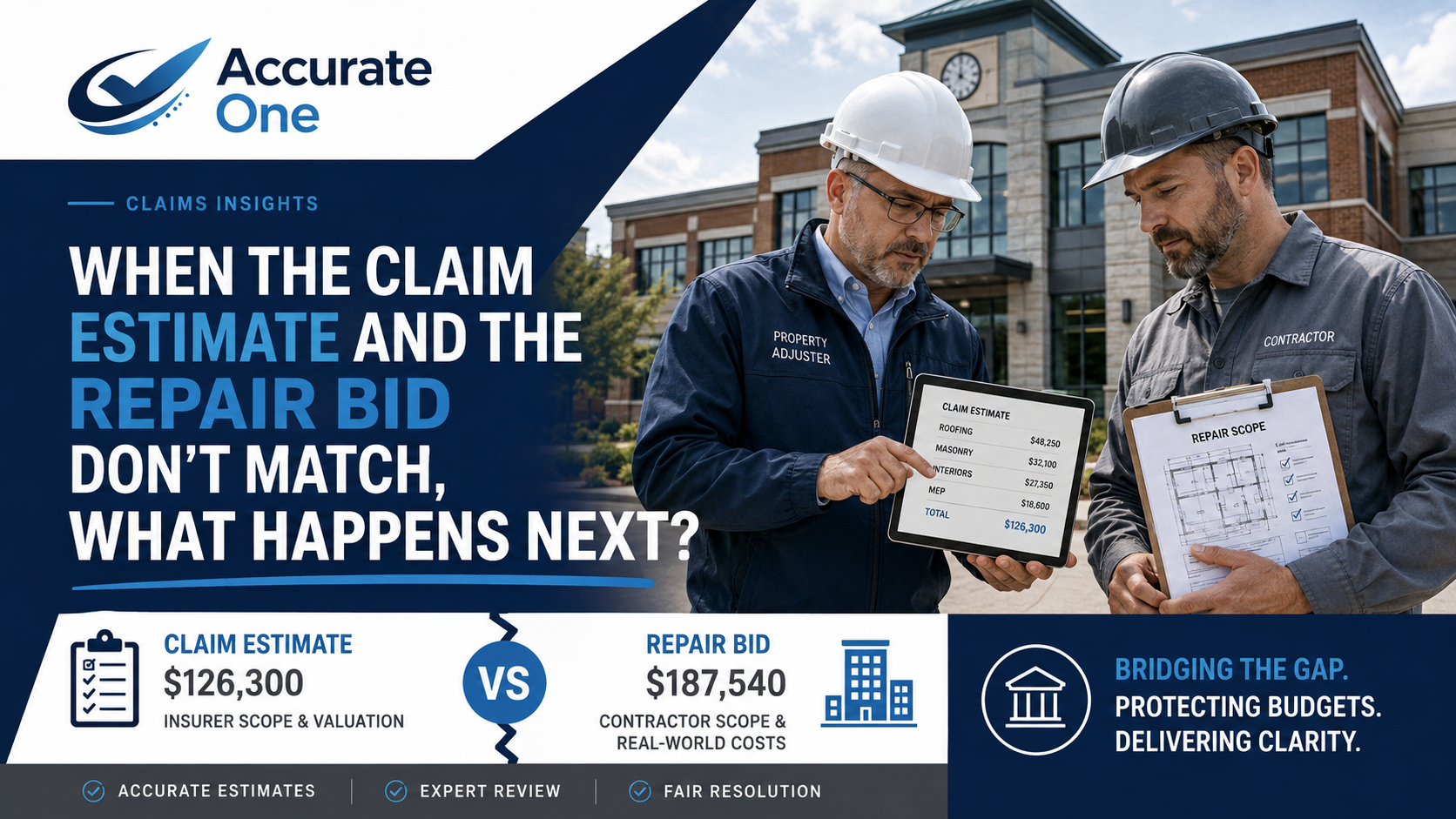
A property claim can appear to be moving smoothly until the contractor reviews the loss and the numbers no longer line up. The original estimate may account for visible damage, standard pricing, and an expected repair sequence. But real-world construction can introduce conditions that were not fully captured at the beginning.
For a municipality, that gap can create more than a simple estimating disagreement. It can create budget uncertainty, additional approvals, delays, supplements, and questions about whether the original scope was complete enough to support the actual repair.
Why the Numbers Separate
Commercial property losses are rarely as simple as replacing one damaged component. The final repair cost can be affected by conditions that are difficult to understand without both claims experience and construction knowledge.
- The initial scope may not capture all damaged materials or required repair steps.
- Local labor and material pricing may differ from generalized assumptions.
- Code requirements can change how the repair must actually be completed.
- Access, sequencing, equipment, and site conditions may affect the practical cost of the work.
- Hidden damage may only become clear as the repair scope is developed in greater detail.
None of these conditions automatically mean the original estimate was careless. They do, however, show why an estimate built only from a claims perspective may not always reflect the full construction reality of the loss.
Contractor-Backed Estimating Adds a Different Layer of Confidence
Contractor-backed estimating brings actual repair knowledge into the estimating process. Instead of asking only whether the estimate is technically supported, the process also asks a practical question:
Can the repair actually be completed for the scope and price shown in the estimate?
Accurate One combines experienced commercial property adjusters with general contractor-backed estimating capability. That means the estimate can be evaluated against real-world construction methodology, regional pricing, repair feasibility, and the actual scope required to complete the work.
The goal is not to inflate an estimate or replace the adjuster’s judgment. The goal is to create a stronger connection between the claim file and the work that will ultimately have to be performed.
Why That Matters for Municipalities
Municipal property claims often involve public buildings, administrative facilities, schools, utilities, or other assets where repair decisions affect budgets, operations, and public accountability. When the estimate and actual repair cost diverge significantly, the consequences can extend well beyond the claim file.
A more construction-informed estimate can help reduce avoidable supplements, limit rework, support clearer financial planning, and give decision-makers greater confidence before the repair process moves too far downstream.
A Better Question to Ask
The question is not simply, “Is the estimate complete?” A stronger question is, “Does this estimate reflect the repair that will actually have to be performed?”
When claims expertise and construction expertise are aligned earlier in the process, municipalities can move forward with greater clarity, fewer surprises, and a stronger connection between the estimated loss and the real cost of restoring the property.
Need Commercial Property Claims Support?
Accurate One provides experienced commercial property adjusters and contractor-backed estimating support designed to bring greater confidence to scope, pricing, and repair feasibility.